Judged by a Till: The Self-Checkout Shame Memes Running Britain’s Group Chats
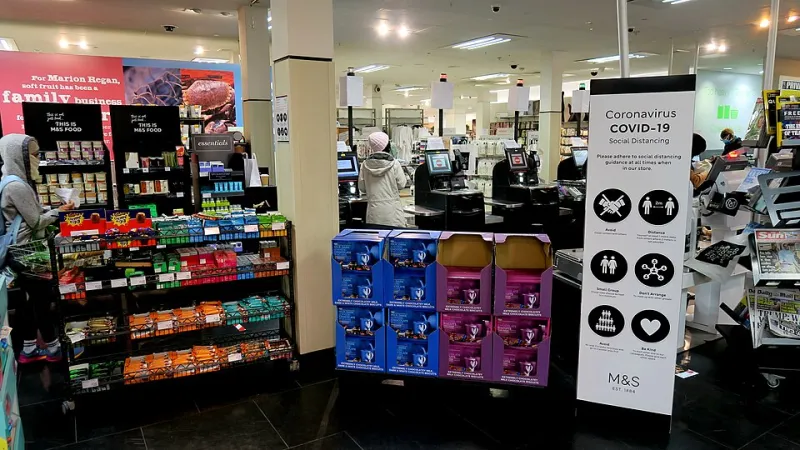
Photo: Kwh1050, CC BY-SA 4.0, via Wikimedia Commons
There is a specific British horror that does not involve ghosts, taxes or the phrase ‘we need to talk’. It involves a supermarket self-checkout, a bag of reduced-price croissants and a machine that has decided, on the basis of nothing at all, that you are trying to steal a potato.
You know the moment. The screen freezes. The voice — calm, polite, utterly damning — announces: ‘Unexpected item in the bagging area.’ A light above your head begins to glow like a tiny police helicopter. The queue behind you does not gasp, because this is Britain; it simply exhales in a way that says, ‘Of course. Him.’ And you, a grown adult with a mortgage and a reusable bag, turn to the machine and say, ‘Sorry.’
That is the entire meme. It has been the entire meme for years. In 2026, it is practically a national genre.
The Voice That Says You’ve Failed Civility
Self-checkout machines do not shout. That would be too honest. Instead they speak in the tone of a disappointed librarian who has found a crisp packet in the returns bin. ‘Please place the item in the bagging area.’ ‘Please wait for assistance.’ ‘Unexpected item.’ Every sentence is technically polite and deeply accusatory, which is precisely why it translates so well into meme form.
The classic image is simple: a shopper frozen mid-bag, eyes wide, one hand hovering over a pack of own-brand hummus. The caption usually reads something like ‘POV: the machine has decided you are a criminal because you breathed near the scales’. Another favourite is the mock-heroic confession: ‘I’ve just been told off by a Tesco till and honestly I need a lie down.’
What makes it work is the gap between the crime and the punishment. You have not robbed a bank. You have put a bag down too quickly. But the machine reacts as if you have attempted to smuggle a entire rotisserie chicken out of the store in your sleeve. The meme economy feeds on that disproportion.
A Very British Technology: Guilt, Queues and the Assistance Light
Britain has a complicated relationship with queues, politeness and being told what to do by a machine. Self-checkouts arrived promising speed and convenience. They delivered a small-scale social experiment in which every shopper becomes a contestant on a game show they did not audition for.
The assistance light is the star of the show. It is the office ‘reply all’ of retail: a bright, silent beacon that says someone has failed, and everyone must now wait. Memes about the light are everywhere. ‘The assistance light has been on for four minutes and I have started to question my life choices.’ ‘Staff member appears only when I have given up and started scanning items with my eyes.’ ‘Please wait for assistance is my current relationship status.’
There is also the matter of the apology. No other country apologises to a till quite like Britain. We say sorry to the machine, sorry to the queue, sorry to the meal deal we have accidentally scanned twice. The meme version is usually a screenshot of a group chat: ‘I just said sorry to a self-checkout and it said unexpected item, so now we’re enemies.’
The Meme Ecosystem: Receipts, Reaction Images and Group-Chat Confessions
The self-checkout meme ecosystem has several dependable formats. First, the POV post: a photo of the screen, a caption describing the exact emotional weather of the shopper. Second, the reaction image: a blurry shot of someone staring blankly at a till, used to reply to any minor inconvenience. Third, the confession: a text post detailing a small act of till-related shame, usually involving a bag, a banana or a bottle of wine that refuses to be weighed.
Then there is the metaphorical layer. ‘Unexpected item in the bagging area’ has become a handy shorthand for anything that disrupts modern life. A work email that makes no sense. A train cancellation. A group chat that suddenly turns serious. The phrase is flexible, familiar and just absurd enough to be shareable.
And because supermarket self-checkouts are everywhere — Tesco, Sainsbury’s, Asda, Morrisons, Aldi, Lidl, the lot — the memes travel without explanation. Everyone has a local version. Everyone has a story about the machine that refused to believe they had bought a carrot.
Why It Keeps Going Viral
The obvious answer is that it is relatable. The slightly more interesting answer is that it is relatable in a very specific British way. It combines low-stakes humiliation, public embarrassment and a deep national instinct to apologise for existing. It is also, crucially, a shared experience that does not require political opinion or cultural knowledge. You do not need to know what a meme is to have been judged by a till.
In 2026, the self-checkout has become a dependable shorthand for modern UK life: the feeling of being watched, processed and mildly scolded by technology that was supposed to help. The memes work because they turn that feeling into a punchline. They are not angry. They are not even particularly savage. They are just tired, polite and very British.
So the next time the machine announces an unexpected item, remember: you are not alone. You are part of a long and proud tradition of shoppers apologising to robots while a queue silently updates its opinion of you. And somewhere, a group chat is already turning it into a meme.