Diagonal Thinking: Britain's Supermarket Car Park Is Now a Fully Functioning Courtroom
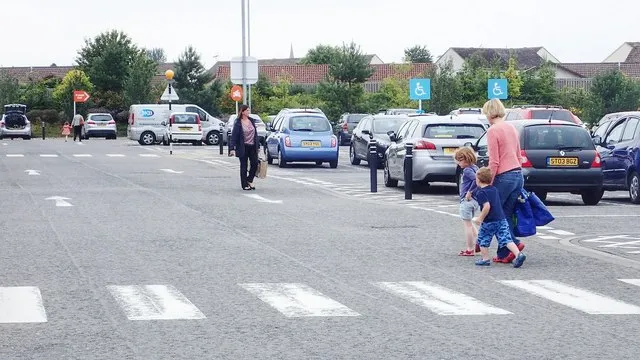
Photo: Mick Garratt , CC BY-SA 2.0, via Wikimedia Commons
There is a particular noise a British person makes when they spot a car straddling two bays. It is not quite a gasp and not quite a laugh. It is a small, sharp inhale — the sound of a citizen deciding, in real time, whether to become a witness. Within four seconds the phone is out. Within forty, the photo is in the local Facebook group. Within four minutes, somebody has typed the words 'no words' and the jury is seated.
Welcome to the car park. Not the one in the town centre with the suspicious stairwell, but the big one attached to a supermarket, where the lines are painted with hope and ignored with gusto. This is Britain's most reliable source of low-stakes drama, and it deserves to be taken exactly as seriously as we take it — which is to say, far too seriously indeed.
The scene of the crime
A supermarket car park is a civic arena pretending to be a piece of tarmac. It has rules, painted arrows, a trolley bay nobody uses correctly and a parent-and-child zone that functions as a moral compass for the entire nation. It also has witnesses. Dozens of them, all sitting in their cars, all pretending to check their phones, all absolutely clocking you as you reverse into the one spot that was clearly meant for a Fiat 500.
What makes car park content so dependable is that the stakes are almost zero. Nobody is hurt. Nobody is really out of pocket. The only thing at risk is a stranger's reputation in a group called something like 'Spotted in [Town Name] — Keep It Friendly :)' and the concept of personal dignity. That is the sweet spot for British internet humour: a wrong has been committed, but not so wrong that anyone has to call the police.
The offence tiers, ranked
We begin with the offences themselves, because a car park post lives or dies on the quality of the parking. A photo of a perfectly parked car is not content. It is a parking space with a story problem.
1. The diagonal anything. Usually an Audi, occasionally a BMW, always with a private plate that spells something like 'B1G DAZ'. The diagonal park is not an accident. It is a statement. The driver has looked at the lines, considered the lines, and chosen to transcend them. The caption writes itself, but we will get to that.
2. The parent-and-child bay without a child. This is the crown jewel of car park outrage, because it combines a clear rule with a visible absence. The photo almost always features an enormous vehicle and, in the background, a single child-free adult walking briskly towards the store. The comment section becomes a tribunal. Somebody will mention Blue Badges. Somebody else will mention their nan. It escalates beautifully.
3. The borrowed Blue Badge. A rare and serious entry, usually spotted by someone who has strong opinions about enforcement. These posts are less funny and more forensic, but they still unite the group in a shared sense of 'well, I never'.
4. The trolley abandoner. The trolley left at a jaunty angle between two cars is not just bad parking; it is a philosophy. It says: my journey ended, and so did my interest in consequences. The photo is always taken from a slight distance, as if the photographer is documenting wildlife.
5. The double-bay door protector. Understandable. Selfish. Relatable. This is the offence that splits the group chat, because half the commenters are furious and the other half are quietly checking whether they have done it themselves this week.
6. The 'just popping in' pavement parker. The most brazen of the lot. The car is not in a bay at all. It is on the kerb, near the entrance, hazards blinking like a confession. The caption is always the same, and it is always right.
The vigilantes, ranked
Every car park post needs a photographer, and not all photographers are created equal.
The documentarian takes one photo, crops out the number plate, and posts it with a caption so minimal it could be a haiku. 'Really?' That is it. That is the post. The restraint is devastating.
The comment-section KC arrives in the comments to lay out the case in four paragraphs, citing the Highway Code, the shop's own signage and a previous incident from 2019. They are not angry. They are thorough. They are, frankly, the best of us.
The trolley-return hero is the counter-meme, and the reason the ecosystem stays balanced. Every so often, someone posts a photo of a trolley being returned properly, with the caption 'Faith restored'. It gets a fraction of the engagement of the diagonal Audi, which tells you everything you need to know about the internet.
The 'name and shame' merchant is the one who wants justice to be swift, public and mildly unhinged. They are the reason group admins have a job.
The captions that do the heavy lifting
A car park photo without a caption is just a picture of a car. The caption is where the passive aggression becomes art. The top tier, in no particular order: 'No words.' 'Absolutely no need.' 'Hope you are proud of yourself.' 'This you?' 'The entitlement is unreal.' And the classic, delivered with the weary authority of a disappointed parent: 'Really?'
None of these are clever. That is the point. They are the internet equivalent of a sharp look across a waiting room. They do not solve anything, but they make everyone feel briefly united, which is basically what a local Facebook group is for.
Why we cannot look away
Car park memes are a morality play with a number plate. They let us perform outrage without consequences, and they let us do it together. They are also endlessly renewable, because Britain has a lot of car parks and a seemingly limitless supply of people who believe the lines are a suggestion.
The next time you see a diagonal Audi, do not despair. Take a breath. Take a photo. Crop the plate. And remember: you are not just witnessing bad parking. You are participating in one of Britain's great civic traditions.
The verdict
Ranked from top to bottom, the car park post is the most dependable genre in British group-chat humour: low stakes, high engagement, zero chance of anyone agreeing on the correct punishment. The diagonal Audi remains the undisputed champion, the parent-and-child bay remains the moral flashpoint, and the trolley-return hero remains the only person in the entire story who has read the room.
And somewhere, in a group chat in a town you have never heard of, a person is typing 'no words' about a car they will never see again. Justice, of a sort, is served.